




Check out this article next

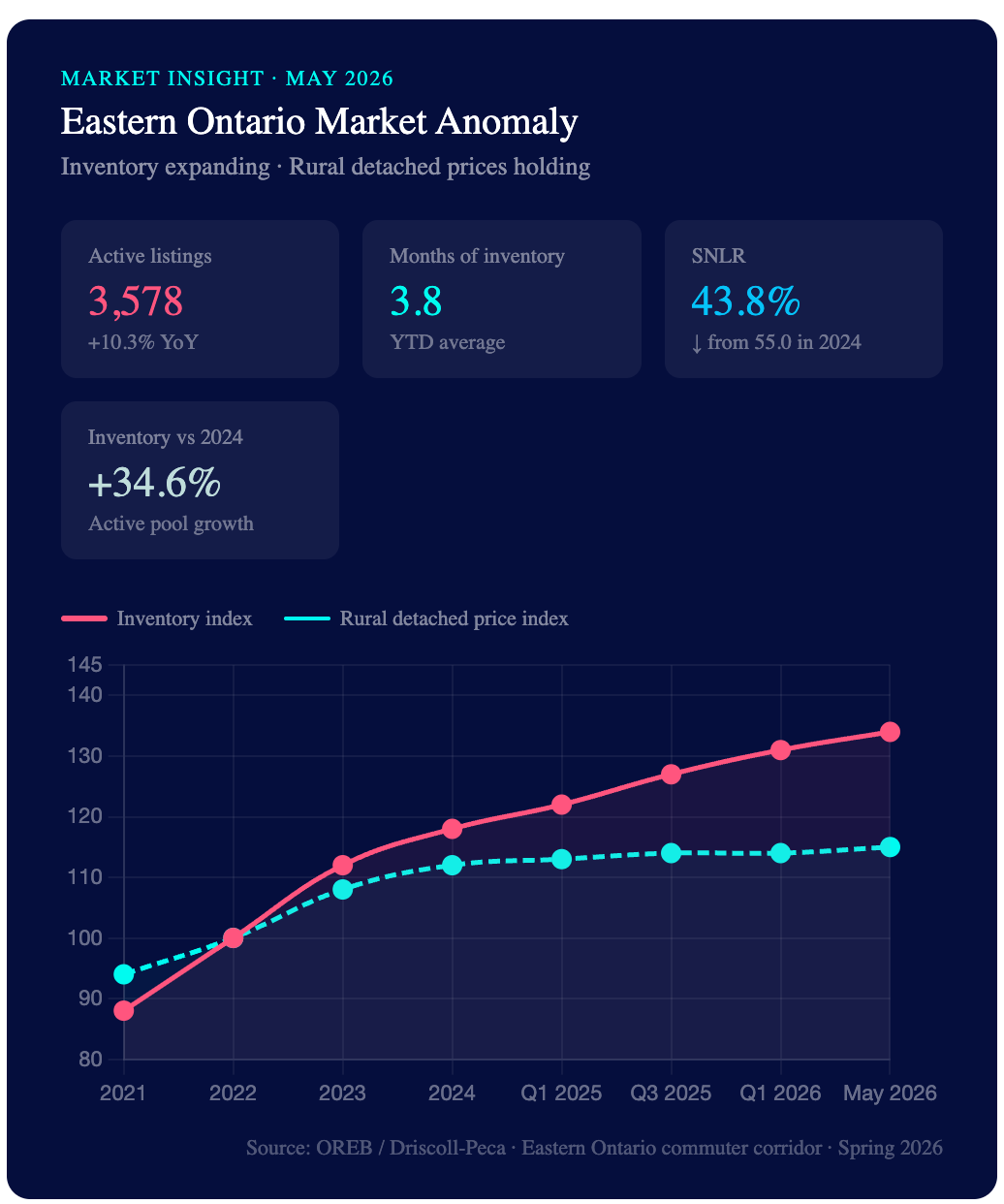
One of the strongest assumptions entering 2026 was that rising inventory would quickly produce broad downward pricing pressure across Eastern Ontario.
That has not fully happened.
Inventory has increased across multiple segments, months of inventory have expanded, and buyers generally have more negotiating room than during earlier high-velocity periods. Yet pricing behavior across many rural and detached segments remains more stable than broader market narratives would suggest.
This does not mean the market is accelerating.
What it does suggest is that Eastern Ontario is experiencing a more selective market recalibration rather than a uniform correction.
That distinction matters for:
The current environment increasingly rewards precision.
Across Eastern Ontario, buyers are seeing:
Inventory expansion has changed the pace of decision-making. Properties that previously received immediate attention may now sit longer while buyers:
This represents a major behavioral shift from earlier low-inventory conditions. At the same time, inventory growth is not evenly distributed across every property type.
Properties carrying:
are generally experiencing more resistance. Meanwhile, properties offering:
continue attracting relatively stable demand.
Forward-Looking Observation: Inventory growth alone is no longer enough to predict pricing direction. Buyers increasingly separate technically functional assets from technically uncertain ones. For a detailed look at how inventory conditions are playing out in one specific community, see our North Grenville Inventory Pulse report.
Many buyers remain active. What has changed is:
Across Eastern Ontario rural and waterfront markets, buyers increasingly investigate:
This creates a market environment where some listings experience extended days on market despite broader demand remaining present. The issue is often not whether buyers exist. The issue is whether buyers view the property as technically predictable.
This distinction becomes especially important in:
Properties with unresolved technical questions increasingly lose momentum faster than during previous market cycles. For a deeper understanding of the technical risks buyers are evaluating, see why septic systems fail on limestone soil in Eastern Ontario.
Forward-Looking Observation: Eastern Ontario buyers are becoming more risk-sensitive rather than purely price-sensitive.
In many Eastern Ontario segments, longer days on market increasingly reflect:
Buyers are taking more time to evaluate:
A property may still attract strong interest while requiring:
As a result, transaction timelines are stretching even when pricing remains relatively stable. This creates a market environment where:
Forward-Looking Observation: Days on market should increasingly be interpreted alongside technical complexity, not as an isolated weakness indicator.
In the current Eastern Ontario environment, certainty increasingly matters just as much as presentation and pricing.
Listings that reduce ambiguity often perform better. This includes properties where sellers can clearly demonstrate:
Meanwhile, properties with unresolved technical uncertainty increasingly experience:
This trend is especially important for:
As buyer caution rises, technical transparency becomes part of marketability itself. Understanding shoreline restrictions and waterfront due diligence is increasingly part of what sellers must be prepared to demonstrate.
Forward-Looking Observation: Sellers who proactively organize technical documentation may reduce negotiation friction in slower inventory environments.
One of the strongest themes emerging in spring 2026 is the growing divide between technically straightforward properties and technically uncertain ones. That divide increasingly shapes:
A rural property with:
may behave very differently from a visually similar property carrying unresolved technical risk.
This segmentation is likely to continue. As regulatory scrutiny, environmental awareness, and infrastructure costs increase, buyers are placing greater value on predictability. The result is not necessarily a collapsing market. It is a more analytical one.
Buyers should evaluate:
Sellers should evaluate:
The strongest-performing properties increasingly reduce ambiguity before negotiation begins.
Market conditions in Eastern Ontario are increasingly segmented by property type, community, and technical profile. A general market reading rarely tells the full story for a specific acquisition or sale decision.
Does rising inventory mean Eastern Ontario prices are falling?
Not necessarily. Inventory growth has increased buyer choice and slowed decision timelines, but pricing behavior remains uneven across property types. Technically straightforward properties continue showing stronger resilience than properties carrying unresolved infrastructure or regulatory concerns.
Why are waterfront homes taking longer to sell in 2026?
Longer selling timelines increasingly reflect buyer due diligence rather than automatic demand collapse. Buyers are paying closer attention to shoreline regulation, flood exposure, insurance costs, septic systems, and redevelopment limitations before firm commitment.
What type of properties remain strongest in the current market?
Properties offering infrastructure clarity, manageable maintenance exposure, modern systems, and fewer technical unknowns generally continue attracting steadier buyer interest.
What is the biggest seller mistake in the current environment?
Many sellers still focus primarily on pricing while underestimating the role of technical transparency. Buyers increasingly want documentation and predictability before proceeding confidently.
If you are navigating this environment as a buyer or seller and want to understand exactly where your target property or listing sits within the current recalibration, fill out the form below and the Driscoll-Peca Team will reach out to walk you through the conditions specific to your situation.
Many rural land buyers assume that if a property was considered buildable several years ago, the approval process remains essentially unchanged today. In Eastern Ontario,…
Read Article
Share My QR |
|