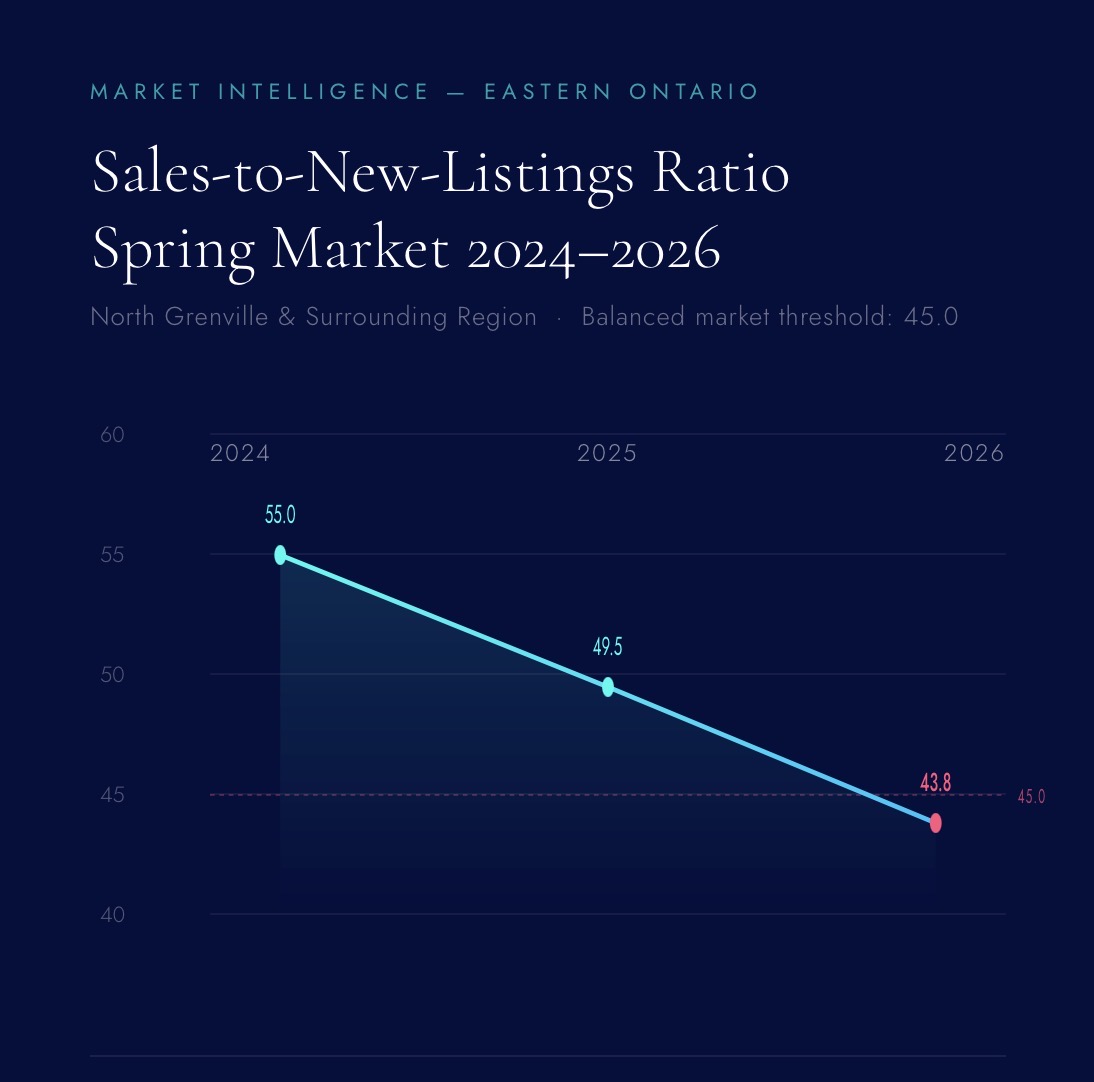
The 43.8 Threshold: Identifying the Regional Shift
The regional Sales-to-New-Listings Ratio (SNLR) has descended to 43.8 as of March 2026, a sharp decline from the 55.0 recorded just two years prior. In the context of North Grenville, this suggests that the frantic absorption of new inventory common in previous spring markets has slowed. Sellers who anticipate multiple-offer scenarios as a default strategy are overlooking the statistical reality: more than half of the new inventory entering the market is currently remaining active past its initial cycle.
Current regional data indicates a market transitioning from balanced to oversupplied. For North Grenville property owners, this requires a pivot from "price discovery" to "price precision." When the SNLR drops below 45, the margin for error on initial list price evaporates, as the accumulation of active listings provides buyers with ample alternatives.
Inventory Velocity and the 3.8-Month Buffer
Active listings across the region reached 3,578 units in March, representing a 10.3% year-over-year increase. More critically, the Months of Inventory (MOI) has climbed to a year-to-date average of 3.8 months. While North Grenville often maintains a tighter supply than the broader regional average, the upward trajectory of these figures signals a fundamental change in buyer behavior.
Buyers are no longer operating under the "scarcity mindset" that defined the 2024 market. With nearly four months of supply available regionally, the pressure to transact immediately has been replaced by a desire for comparative analysis. Sellers in Kemptville and surrounding hamlets must recognize that their property is now competing against a 34.6% larger pool of available homes than it was two springs ago.




The Pricing Anomaly: Overcoming the Stale Listing Risk
As the regional MOI pushes toward the 4-month mark, the risk of a listing becoming "stale" increases exponentially. Data shows that the current market rewards properties that are positioned as the best value within their specific segment immediately upon launch.
In North Grenville, where rural residential properties often have higher carrying costs, a prolonged Days on Market (DOM) period can lead to significant price erosion. Observational patterns suggest that properties failing to secure an offer within the first 21 days are currently seeing price adjustments or are being bypassed for newer, more aggressively priced inventory. This is a direct result of the 10.3% increase in competition entering the market this spring.
Buyer Behavior Insight: The Rise of the Condition
With the SNLR at 43.8, buyers have regained significant leverage. Market signals indicate a return to standard due diligence periods. Financing, home inspection, and even the sale of a buyer's property are reappearing as standard components of the negotiation process. Sellers who refuse to acknowledge this shift risk losing qualified buyers to competing listings in nearby Kanata or Stittsville, where similar inventory is increasingly available.
Strategic Decision: The Pre-Emptive Listing Correction
Sellers entering the North Grenville market this month must decide whether to price at the "ceiling" and risk a 60-day market duration or price at "fair market value" to capture the current 43.8% of active buyers. Waiting for the market to "pick up" later in the spring is a high-risk strategy in 2026, as the data shows inventory is building faster than sales are occurring.
Market data reflects available regional information for the stated period. For verified figures specific to your target area, contact the Driscoll-Peca Team directly.
Check out this article next